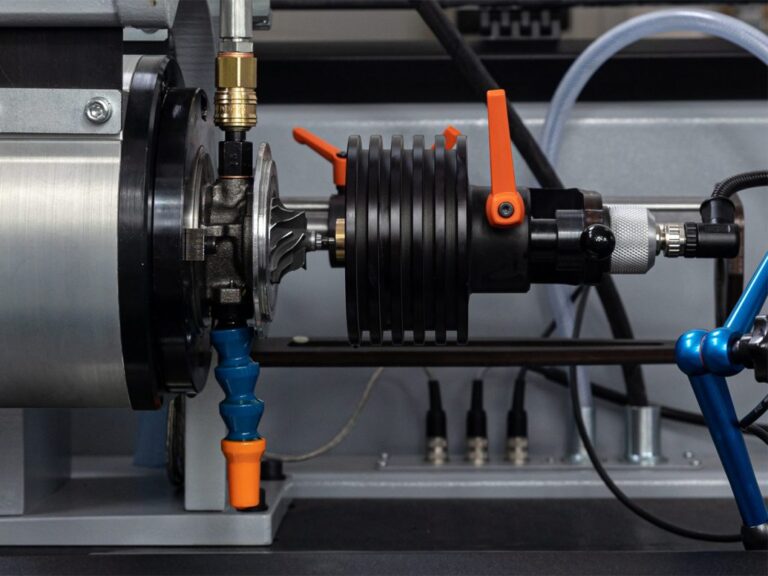
Here’s how to configure a streamlined reconditioning center that matches your volume and model mix.
A turbocharger reconditioning shop needs at least two distinct balancing capabilities, including rotor balancing before assembly and high-speed core balancing after assembly. Many shops also require low-speed core balancing for large-frame commercial or marine turbochargers, and flow bench testing for final performance verification. Running each of these on a separate standalone machine means four machines, four footprints, four sets of handling between stations and four capital expenditures.
Cimat, an Ascential Technologies brand, simplifies this approach by offering combined balancing systems that integrate two capabilities in a single housing, thereby cutting floor space, handling time and equipment investment while maintaining the measurement quality that BorgWarner and Garrett have validated for OEM production. With machines installed in more than 2,000 workshops across 90+ countries, Cimat’s combined platforms are the most widely deployed turbocharger balancing systems in the reconditioning industry.
This article maps every combination and standalone option so you can configure the right testing center for your operation.
Why Combined Machines Reduce Cost Per Core
The economics are straightforward. Every time a turbocharger core is moved between machines, there is:
- Handling time — picking up the core, carrying it to the next station and mounting it
- Damage risk — a dropped or bumped core after balancing can undo the correction
- Floor space — each standalone machine needs its own footprint, utilities and access
A combined machine eliminates the transfer between the two operations it integrates. For a shop processing 150–200 cores per shift, that handling reduction compounds into meaningful throughput recovery.
All Cimat combined machines share the platform’s core engineering advantages:
- Five-stage oil filtration
- Two-element adapter system (10 plates + 10 sleeves = 100 configurations, under 30 seconds changeover)
- Full-range vibration measurement at up to 300,000 rpm
- And automatic correction point calculation.
A Look at Integrated Machine Options
Below we review Cimat’s advanced, integrated machine offerings to help capture efficiencies and streamline your testing centers.
Twin Series: High-Speed + Low-Speed Core Balancing in One Machine
The Twin machines combine high-speed core balancing (for passenger car and light commercial turbochargers) with low-speed core balancing (for larger commercial, off-highway, agricultural and marine turbochargers) on a single platform.
CMT-VSR Twin
The CMT-VSR Twin combines:
- Stand 1: CMT-VSR — high-speed core balancing (max turbine 91/80 mm, max compressor 109 mm, max core 240 mm, 300,000 rpm, 150–200 cores per shift)
- Stand 2: CMT-TR — low-speed core balancing (max core mass 16 kg, 4,000–20,000 rpm, measurement uncertainty 0.02–0.3 gmm light-duty / 0.15–0.9 gmm heavy-duty)
CMT-VSR Big Twin
The CMT-VSR Big Twin expands the high-speed stand to the Big frame:
- Stand 1: CMT-VSR Big — (max turbine 134/114 mm, max compressor 179 mm, max core 300 mm, 300,000 rpm)
- Stand 2: CMT-TR — same low-speed specs, with balancing speed up to 40,000 rpm
| Specification | CMT-VSR Twin | CMT-VSR Big Twin |
|---|---|---|
| High-speed: max turbine | 91 / 80 mm | 134 / 114 mm |
| High-speed: max compressor | 109 mm | 179 mm |
| High-speed: max core diameter | 240 mm | 300 mm |
| Low-speed: max core mass | 16 kg | 16 kg |
| Low-speed: balancing speed | 4,000–20,000 rpm | Up to 40,000 rpm |
| Machine mass | 450 kg | 450 kg |
Select Twin when your shop balances both passenger car cores (high-speed) and commercial/industrial cores (low-speed) and you want both capabilities in a single machine footprint. With just one machine featuring three quality gates you can simply balance, flow, ship.
Combined high-speed core balancing and flow-bench platforms cut handling steps, floor space and cycle time. Same record, fewer touches and faster ship.
Basic Series: Core + Rotor Balancing in One Machine
The Basic machines are the most popular configuration for full-service reconditioning shops because they combine the two sequential stages of turbocharger balancing — rotor balancing (Stage 1) and high-speed core balancing (Stage 2) — in a single housing.
CMT-VSR Basic
The CMT-VSR Basic combines:
- Stand 1: CMT-VSR Big — high-speed core balancing (134/114 mm turbine, 179 mm compressor, 300,000 rpm)
- Stand 2: CMT-TR Polimer — belt-driven rotor balancing (20 g–5 kg, 200 mm max diameter, 2 correction planes, 0.05 gmm min residual, up to 16,000 rpm)
CMT-VSR Big Basic
The CMT-VSR Big Basic adds enhanced rotor balancing features:
- Stand 1: CMT-VSR Big — same high-speed core specs, 179 mm max compressor wheel, 300 mm max core diameter
- Stand 2: CMT-TR Polimer — rotor balancing with ≥ 95% unbalance reduction ratio, continuously adjustable servo drive speed control and both specific rotor calibration (test weight) and “ABC” rotor calibration (no calibration run required)
| Specification | CMT-VSR Basic | CMT-VSR Big Basic |
|---|---|---|
| Core: max compressor wheel | 179 mm | 179 mm |
| Rotor: min residual | 0.05 gmm | 0.05 gmm |
| Rotor: reduction ratio | — | ≥ 95% |
| “ABC” calibration | — | Yes |
| Machine mass | 450 kg | 450 kg |
Choose Basic when you want to handle the complete rotor-to-core balancing workflow in a single machine and minimize handling between stages.
Standalone Machines for Targeted Capability
CMT-TR: Low-Speed Core Balancing
The CMT-TR is a dedicated low-speed core balancing machine for commercial vehicle, off-highway, agricultural and marine turbochargers. Max core mass 16 kg, measurement uncertainty 0.02–0.9 gmm, balancing speed up to 40,000 rpm.
Select when your shop already has high-speed capability and needs to add large-frame low-speed balancing.
CMT-TR Polimer: Rotor Balancing
The CMT-TR Polimer is a dedicated rotor balancing machine for the first stage of reconditioning, which entails two-plane dynamic balancing of compressor and turbine wheels. Key stats: 20 g–5 kg, 0.05 gmm min residual, up to 16,000 rpm, with both specific and “ABC” calibration.
Choose when you need a dedicated rotor station running in parallel with core balancing to increase overall throughput.
Three Reconditioning Center Configurations
Configuration 1: Compact single-machine center
CMT-VSR Basic — rotor balancing + high-speed core balancing in one housing. Minimum footprint, minimum investment. Best for shops starting out or processing moderate volume.
Configuration 2: Parallel dual-station center
CMT-VSR Pro + CMT-TR Polimer — rotor and core balancing run simultaneously on separate machines, with integrated correction cutting on the Pro. Best for higher-volume operations where throughput is the constraint.
Configuration 3: Full multi-capability center
CMT-VSR Big Twin + CMT-TR Polimer + Turbo Test flow bench — covers every stage of the quality process for all vehicle types from passenger car to marine.
These benches are OEM-validated – in fact, OEMs trust these machines to validate their own turbos.
Installed in 2,000+ workshops across 90 countries, Cimat’s turbocharger balancing systems are the most widely deployed in the reconditioning industry.
Frequently Asked Questions
What is the advantage of a combined balancing machine over separate standalone machines?
A combined machine eliminates the handling step between two operations — picking up the core, carrying it to the next station and remounting it. For a shop processing 150–200 cores per shift, that handling reduction compounds into meaningful throughput recovery, reduced damage risk and smaller floor space requirements.
What is the difference between Twin and Basic configurations?
Twin machines combine high-speed and low-speed core balancing, expanding the range of turbocharger sizes you can balance on one platform. Basic machines combine core balancing and rotor balancing, covering the two sequential stages of the reconditioning workflow in one housing. Choose Twin if your bottleneck is turbocharger size range; opt for Basic if your bottleneck is workflow stages.
What is “ABC” rotor calibration?
“ABC” rotor calibration is a simplified calibration process that does not require calibration runs with test weights. It enables faster setup when switching between rotor types, which is particularly valuable for shops that process a wide variety of turbocharger models daily. The alternative is specific rotor calibration, which uses test weight runs for higher precision on individual models.
Can one machine handle the entire turbocharger balancing workflow?
The CMT-VSR Basic combines rotor balancing and high-speed core balancing in a single housing, covering both sequential stages of the reconditioning process. For complete quality assurance including performance verification, add a Turbo Test flow bench.
What rotor mass range does the CMT-TR Polimer support?
The CMT-TR Polimer balances turbocharger rotors from 20 g to 5 kg with journal diameters from 5 to 25 mm — covering compressor and turbine wheels for passenger cars, light-duty trucks and heavy-duty trucks.
How do I configure a complete turbocharger reconditioning center?
Three typical configurations: (1) Compact — CMT-VSR Basic (combined rotor + core). (2) Parallel — CMT-VSR Pro + CMT-TR Polimer (separate stations for throughput). (3) Full multi-capability — CMT-VSR Big Twin + CMT-TR Polimer + Turbo Test flow bench (all stages, all vehicle types).