A turbocharger that is perfectly balanced can still underperform. Balancing ensures the rotating assembly runs smoothly but it does not verify that the turbocharger delivers the correct air mass flow, boost pressure response and performance characteristics as intended by its design. That verification is the job of the flow bench.
For turbocharger reconditioning shops, the flow bench is the final quality gate before the unit ships back to the customer. For OEM production, it is the calibration step that confirms every unit meets the performance specification. Skipping it means shipping turbochargers with unknown aerodynamic performance — a risk that generates warranty returns and erodes customer confidence.
Cimat, an Ascential Technologies brand, manufactures turbocharger flow benches that serve both roles including standalone calibration machines and combined balancing-and-flow-bench systems that integrate high-speed core balancing and performance verification in a single platform. These machines and systems are validated by OEMs, including BorgWarner and Garrett, and installed in more than 2,000 workshops across 90+ countries.
What a Turbocharger Flow Bench Measures
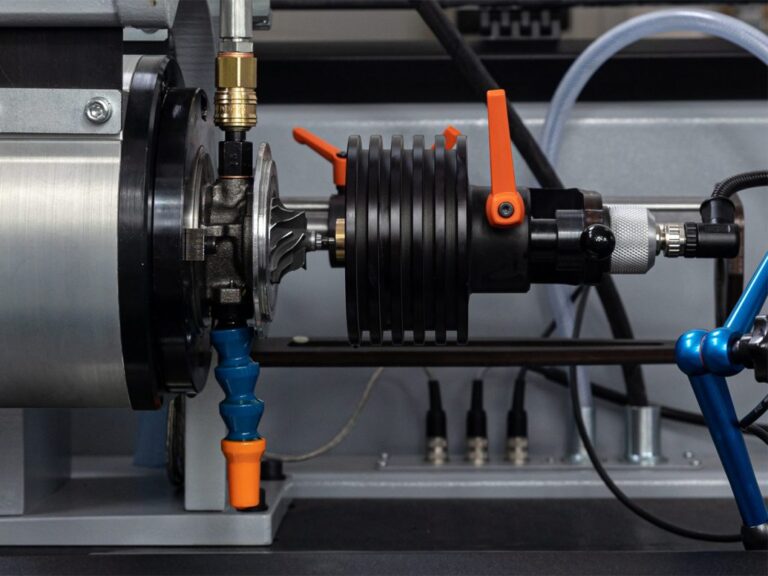
A turbocharger flow bench measures the turbo’s aerodynamic performance under controlled conditions. Compressed air is supplied to the turbine inlet at controlled pressure, driving the turbine wheel and the connected compressor wheel. The bench measures the resulting air mass flow through the compressor side, which is the fundamental performance parameter that determines how much boost the turbocharger delivers to the engine.
The turbocharger is mounted on the bench in its normal operating position with the oil drain directed downward, exactly as it’s installed in a vehicle. This positioning ensures the oil film in the bearing system behaves as it would in operation, which directly affects the turbocharger’s dynamic response and the accuracy of the flow measurement.
Static vs. Dynamic Flow Testing
Static flow testing measures air flow characteristics at fixed operating points, including specific turbine inlet pressures and temperatures. This establishes the turbo’s performance map, which is how much air mass flow it produces at each combination of pressure ratio and shaft speed. Static testing is the baseline for confirming that the reconditioned unit matches the OEM’s performance specification.
Dynamic flow testing measures transient behavior, including how quickly the turbocharger spools up, how air flow changes during acceleration and how the unit responds to changing inlet conditions. This is closer to the turbo’s actual operating environment, where the turbine inlet pressure varies continuously with engine speed and load.
Cimat’s Turbo Test flow benches support both static and dynamic testing in a single platform so you can map the steady-state performance and verify the transient response without moving the turbocharger to a different machine.
A Look at Flow Bench Options
Turbo Test: Standalone Flow Bench
The Turbo Test is a standalone static and dynamic turbocharger flow bench for the calibration of passenger car, light-duty truck and heavy-duty truck turbochargers.
| Parameter | Turbo Test |
|---|---|
| Maximum turbine inlet air pressure | 250 kPa |
| Air mass flow measurement accuracy | ±1 kg/h |
| Maximum mass air flow measurable | 450 kg/h at 1 bar inlet pressure and 25°C |
| Maximum volume air flow measurable | 380 m³/h at 1 bar inlet pressure and 25°C |
| Turbocharger position | Vehicle-mounted orientation with oil drain downward |
Choose Turbo Test when your shop already has separate balancing capability (CMT-VSR family) and needs a dedicated flow bench for final performance verification and calibration before shipping.
Turbo Test Duo: Combined Core Balancing + Flow Bench (Standard Frame)
The Turbo Test Duo combines a high-speed core balancing machine and a turbocharger flow bench in a single platform. The turbocharger core can be balanced and then flow-tested on the same machine without being removed, transported and remounted, which eliminates a handling step and reduces both cycle time and the risk of post-balance damage.
The high-speed balancing stand shares the CMT-VSR platform’s core engineering: compressed air drive, five-stage oil filtration, the two-element adapter system with under 30 seconds changeover, full-range vibration measurement at up to 300,000 rpm and automatic correction point calculation.
| Parameter | Turbo Test Duo |
|---|---|
| Max turbine wheel diameter | 91 mm (inducer) / 80 mm (exducer) |
| Max compressor wheel diameter | 109 mm |
| Max rotational speed | 300,000 rpm |
| Flow bench: max inlet pressure | 250 kPa |
| Flow bench: mass flow accuracy | ±1 kg/h |
| Flow bench: max mass air flow | 450 kg/h |
Opt for Turbo Test Duo when your shop processes standard-frame passenger car and light commercial turbochargers and you want both high-speed balancing and flow testing in a single machine footprint. This allows you to balance, correct, verify and calibrate without moving the core.
Turbo Test Duo Big: Large-Frame Combined Balancing + Flow Bench
The Turbo Test Duo Big is the large-frame version, combining the CMT-VSR Big platform’s expanded turbine and compressor wheel capacity with the same flow bench capability.
| Parameter | Turbo Test Duo Big |
|---|---|
| Max turbine wheel diameter | 134 mm (inducer) / 114 mm (exducer) |
| Max compressor wheel diameter | 179 mm |
| Max rotational speed | 300,000 rpm |
| Flow bench: max inlet pressure | 250 kPa |
| Flow bench: mass flow accuracy | ±1 kg/h |
| Flow bench: max mass air flow | 450 kg/h |
Choose Turbo Test Duo Big when: your operation handles a mix of passenger car and commercial/industrial turbos (up to 179 mm compressor wheel) and you want combined balancing and flow testing for the full size range.
Flow Bench Comparison
| Feature | Turbo Test | Turbo Test Duo | Turbo Test Duo Big |
|---|---|---|---|
| Flow bench | Yes (standalone) | Yes (combined) | Yes (combined) |
| High-speed core balancing | No | Yes (standard frame) | Yes (big frame) |
| Max turbine (inducer / exducer) | — | 91 / 80 mm | 134 / 114 mm |
| Max compressor wheel | — | 109 mm | 179 mm |
| Max turbine inlet pressure | 250 kPa | 250 kPa | 250 kPa |
| Mass flow accuracy | ±1 kg/h | ±1 kg/h | ±1 kg/h |
| Max mass air flow | 450 kg/h | 450 kg/h | 450 kg/h |
| Five-stage oil filtration | — | Yes | Yes |
| Adapter changeover | — | < 30 sec | < 30 sec |
| OEM validated (BorgWarner, Garrett) | Yes | Yes | Yes |
Building a Complete Turbocharger Test Center
As mentioned, the flow bench is the final quality gate. Combined with Cimat’s balancing machines, a complete turbocharger test center might look like:
Option A: Full standalone configuration
- CMT-TR Polimer — rotor balancing (0.05 gmm residual)
- CMT-VSR Pro — high-speed core balancing with integrated correction cutter
- CMT-TR — slow-speed core balancing for large-frame cores
- Turbo Test — standalone flow bench for final calibration
Option B: Compact combined configuration
- CMT-VSR Basic — combined rotor + high-speed core balancing
- Turbo Test Duo Big — combined core verification + flow bench calibration
Both configurations cover the complete quality process. The difference is footprint, handling steps and investment level.
Cimat machines are manufactured in Poland from European industrial components. The company also manufactures balancing machines for drive shafts, crankshafts, clutches, dual mass flywheels, brake discs, engine cooling fans, and industrial wheels and tires.
Frequently Asked Questions
What does a turbocharger flow bench measure?
A turbocharger flow bench measures the turbo’s aerodynamic performance under controlled conditions. Compressed air drives the turbine wheel and the bench measures the resulting air mass flow through the compressor side, which is the fundamental parameter that determines how much boost the turbocharger delivers to the engine.
What is the difference between static and dynamic flow testing?
Static flow testing measures air flow at fixed operating points (specific pressures and temperatures) to build the turbocharger’s performance map. Dynamic flow testing measures transient behavior, such as spool-up response, acceleration characteristics and performance under changing conditions. Cimat’s Turbo Test benches support both in a single platform.
Why must the turbocharger be mounted in the vehicle position during flow testing?
The turbocharger must be mounted with the oil drain directed downward, exactly as it’s installed in a vehicle. This positioning ensures the oil film in the bearing system behaves as it would in operation, which directly affects the turbocharger’s dynamic response and the accuracy of the flow measurement.
Can I balance and flow-test a turbocharger on the same machine?
Yes. The Turbo Test Duo (standard frame, up to 109 mm compressor wheel) and Turbo Test Duo Big (large frame, up to 179 mm compressor wheel) combine high-speed core balancing and flow bench testing on a single platform, eliminating the handling step between the two operations.
What is the flow measurement accuracy of Cimat’s Turbo Test benches?
All Cimat Turbo Test flow benches achieve ±1 kg/h air mass flow measurement accuracy, with a maximum measurable mass air flow of 450 kg/h at 1 bar turbine inlet pressure and 25°C.
When should I choose a standalone flow bench versus a combined Duo system?
Choose a standalone Turbo Test if your shop already has separate balancing capability (CMT-VSR family) and needs a dedicated flow bench. Opt for a Turbo Test Duo if you want to reduce handling steps, floor space and cycle time by combining balancing and flow testing on one platform, which is particularly valuable for higher-volume operations.