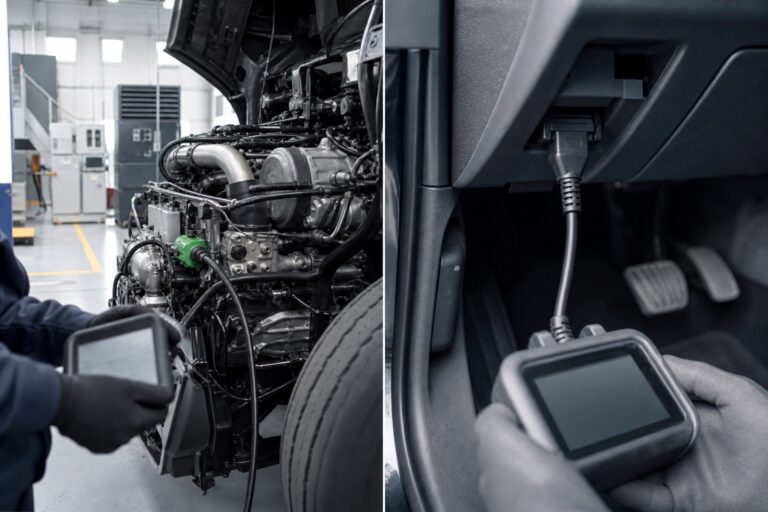
An OBD certification submittal is a gate on your launch, and CARB and EPA control the clock. When an application arrives incomplete, inconsistent, or hard to follow, the reviewer stops, sends questions back, and moves on to the next manufacturer in the queue. Every round trip costs weeks. If the gaps are serious, you can lose an entire review cycle, and a certificate you assumed would land in the spring can slip past the desired start of production. The documentation package is not paperwork you attach at the end. It is the product you are selling to the agency, and its clarity decides whether you clear on the first submittal or spend the summer answering agency questions and scrambling to supply test data to back up the documentation.
The good news: a first-pass clearance is a repeatable outcome, not luck. It comes from a complete, internally consistent package that mirrors how the reviewer reads it, and from finding your own compliance gaps before the agency does. This article covers what a complete OBD certification application contains, how misfire and durability data get analyzed and presented, how the application is submitted to CARB electronically, and how a pre-submittal compliance-risk review shortens certification time across gasoline, diesel, and hybrid programs in automotive, heavy-duty, off-road, and motorcycle programs.
What a Complete OBD Certification Application Contains
The package is built monitor by monitor. For each diagnostic in the OBD system, the application has to explain what the monitor watches, how it decides something has failed, and how it behaves once it does. CARB’s OBD II regulation (title 13 CCR 1968.2) for light- and medium-duty, and 1971.1 for heavy-duty, define what the system must do, and 40 CFR 86.1806 carries the federal requirement. Your job in the application is to show, clearly and consistently, that every required monitor exists and works. Three core deliverables carry that story.
Summary tables map every monitor. The diagnostic summary tables are the reviewer’s index to the whole system. They list each monitor with its malfunction criteria, enable conditions, monitoring timing, and the associated fault code. When the tables are complete and match the rest of the package, a reviewer can navigate the application quickly. When a number in a table disagrees with a functional description or a flow chart, the reviewer stops and asks why, and you are back in the queue.
Functional descriptions explain the intent. Where the tables give the values, the functional descriptions give the narrative: what the monitor is protecting against and the strategy it uses to detect a fault. The functional description not only describes the diagnostic monitors but it is also where the reviewer can find information on how the hardware systems work, especially those that may be unique to that particular application.
Flow charts show the logic. A monitor flow chart walks the decision path from enable conditions through fault detection, one chart per monitor. Good charts let a reviewer confirm the logic without reverse-engineering summary table information, and they surface inconsistencies inside your own team before an agency sees them. A complete application typically includes (among other things):
- Diagnostic summary tables for every required monitor, with fault criteria and enable conditions.
- Functional descriptions that explain system hardware and detection strategy.
- Monitor flow charts that trace each monitor’s decision logic end to end.
- Misfire monitor data and its analysis, covering detection across the operating range.
- Demonstration Durability Vehicle data with monitor demonstration results.
Misfire Monitor Data Analysis
Misfire is the hardest monitor to document well. It has to catch combustion events that fail across engine speed, load, and temperature, and it has to do so without false-tripping on rough roads or normal transients. The application needs to show that the monitor detects misfire at the required rates throughout the operating range, and that the calibration separates real misfire from noise. That means presenting the raw detection data, the analysis behind the thresholds, and the results in a form the reviewer can follow, not just a claim that the monitor passes.
Presentation is half the battle. Two applications can carry the same underlying data and get very different reception. When the misfire analysis is organized around the operating map, ties clearly to the thresholds in the summary tables, and reads consistently with the functional description, the reviewer can confirm compliance quickly. When it is a spreadsheet dump with no narrative, the questions start, and each answer is another cycle.
Demonstration Durability Vehicle Data
Demonstration proves the monitors detect real faults prior to exceeding emissions limits. Monitor demonstration introduces or simulates the malfunction each diagnostic is required to catch and proves the Malfunction Indicator Lamp (MIL) illuminates before the OBD emissions threshold is exceeded. This testing is done using specific emissions test cycles on a vehicle chassis dynamometer. The certification package presents those demonstration results monitor by monitor, so the reviewer sees evidence rather than assertion.
Durability data shows it holds up. DDV data confirms the OBD system continues to perform as the vehicle ages, which is central to CARB’s in-use expectations. This is also where in-use monitoring performance connects: the In-Use Monitor Performance Ratio (IUMPR), a numerator over denominator that counts how often a monitor completes against qualifying driving events, is how CARB verifies monitors actually run often enough in the real world. Documenting that story well up front reduces friction later in Production Vehicle Evaluation (PVE), CARB’s in-production verification of the same system.
Submitting the Application to CARB Electronically
Submission format matters as much as content. Once the package is complete, the manufacturer submits the complete OBD application to CARB electronically through CARB’s certification filing process. A package that is assembled the way the agency expects to receive it, with the tables, descriptions, charts, and data organized and cross-referenced, moves through intake without the back-and-forth that comes from missing files or mismatched versions.
Consistency across the file set is the quiet risk. Electronic submittal exposes any disagreement between documents. A threshold that reads one way in a summary table and another way in a flow chart is obvious when both are in the same package. Reconciling every value across tables, descriptions, and charts before you file is the difference between a clean intake and many rounds of agency Q&A.
Identifying Compliance Risk Before Agency Submittal
Find the gaps before the reviewer does. The single largest lever on certification time is a pre-submittal compliance-risk review: reading your own application the way a CARB engineer will and fixing what would draw a question before it ships. Missing monitors, thresholds that will not survive scrutiny, demonstration results that do not line up with the tables, and internal inconsistencies are all cheaper to fix at your desk than in a formal response weeks later.
A review pass typically checks:
- Completeness: every required monitor is present and documented across all deliverables.
- Consistency: criteria, enable conditions, and thresholds agree across tables, descriptions, and charts.
- Evidence: misfire and DDV data actually support the claimed performance.
- Clarity: a reviewer can follow each monitor’s logic without asking for a rework.
How This Applies Across Powertrains and Vehicle Segments
The deliverables are the same; the details are not. Gasoline, diesel, and hybrid systems each carry their own monitors and their own hard cases. Light-duty OBD communicates over SAE J1979-2, while heavy-duty OBD runs primarily on the SAE J1939 network. Motorcycle and agriculture programs face the same documentation logic on different hardware. Whatever the platform, the package still has to tell one consistent story: here is every monitor, here is how it detects a fault, and here is the data that proves it.
Where WinterPark Fits
This is the team’s core work. WinterPark, OBD Engineering Services and Consulting team, now part of Ascential Care, provides full-service OBD certification documentation for gasoline, diesel, and hybrid powertrains across automotive, heavy-duty, agriculture, and motorcycle programs. That includes diagnostic summary tables, functional descriptions, and monitor flow charts assembled and cross-checked ready for agency submittal.
The group processes the data behind the package. Misfire monitor data and demonstration results are analyzed and presented so a reviewer can follow them, and the complete OBD application is submitted to CARB electronically. Before anything ships, a pre-submittal compliance-risk review reads the application the way the agency will and closes gaps first. Based in Michigan since 2006, with roughly thirty engineers and more than 250 years of cumulative powertrain-development experience, the team works with a long-standing, cooperative relationship with both CARB and EPA.
If a first-pass clearance is the goal, start with the documentation. Reach out to WinterPark to talk through your OBD certification package before it goes to the agency.
Întrebări frecvente
What documents make up an OBD certification application?
The full certification package is made up of many documents, sometimes referred to as an “A-P document” for light- and medium-duty applications or an “A-S document” for heavy-duty applications. At its core, the package contains diagnostic summary tables, monitor checklist, functional descriptions, and flow charts for every required monitor, plus misfire monitor data, and DDV data. Together they show the agency that each monitor exists, detects the fault it is required to catch, and behaves correctly.
Why do OBD submittals get rejected on the first pass?
Most first-pass problems are completeness and consistency issues: a missing monitor, a threshold that creates a gap in detection, or demonstration data that does not line up with the documented criteria. A reviewer who finds these stops and sends questions, which costs a review cycle.
How is the OBD application submitted to CARB?
Manufacturers submit the complete OBD application to CARB electronically through CARB’s certification filing process. Assembling the package the way the agency expects to receive it helps it move through intake without avoidable back-and-forth.
What is a pre-submittal compliance-risk review?
It is a review that reads your application the way a CARB engineer would, before you file, and flags anything that would draw a question: missing monitors, weak thresholds, or internal inconsistencies. Fixing those first is far faster than answering agency questions after submittal.
Does the same process apply to diesel and hybrid programs?
Yes. The deliverables (summary tables, monitor checklist, functional descriptions, flow charts, and other supporting data and files) are the same across gasoline, diesel, and hybrid, and across automotive, heavy-duty, agriculture, and motorcycle (note: diesel applications require a few diesel-specific documents that are not required for gasoline applications). The specific monitors and communication networks differ, but the documentation logic does not.