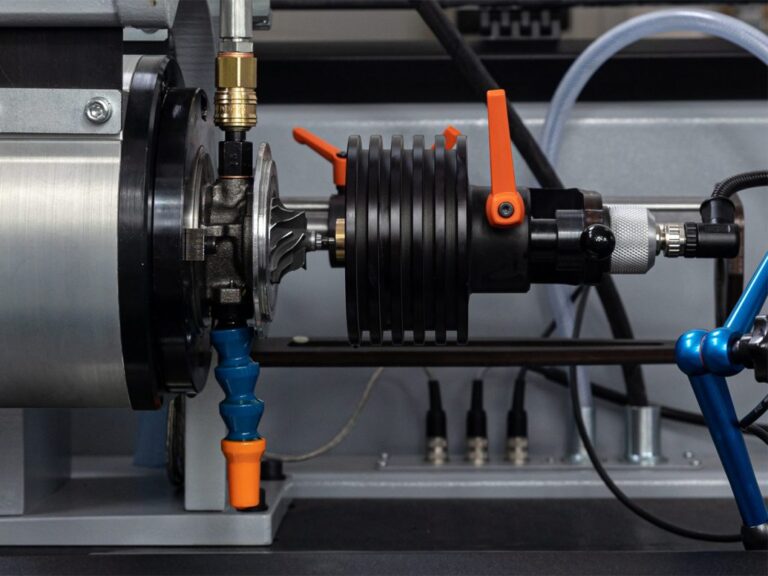
Every rotating component in a defense system — from the turret of a mobile detection and guidance station to the drive shaft of a jet propulsion system to the rotor of a gyroscope inside a cruise missile guidance unit — must be dynamically balanced before it enters service. The consequences of imbalance in defense applications are not vibration complaints or premature bearing wear, as they might be in commercial machinery. They are degraded weapon accuracy, reduced sensor stability, shortened component life in environments where field service is impossible and, in the worst case, mission failure.
Dynamic balancing is the process of measuring and correcting the uneven mass distribution of a rotating component so that its principal axis of inertia coincides with its geometric axis of rotation. In defense manufacturing, the tolerances for that coincidence are among the tightest in any industry with the diversity of components requiring balancing spanning nearly every subsystem of modern platforms.
Why Defense Rotating Components Are Different
Commercial and industrial balancing addresses components that operate in relatively benign environments including electric motors, fans, pumps and turbocharger rotors that run at known speeds under controlled conditions. Defense rotating components present a fundamentally different challenge profile from extreme operating environments to regulatory and traceability requirements.
Extreme operating environments. Components may operate at temperatures from −51°C to +71°C (MIL-STD-810 extremes) under sustained vibration and shock loads, and in orientations that change continuously during flight or maneuver. An imbalance that is tolerable in a fixed industrial installation can generate resonance or bearing degradation in a platform that experiences multi-axis vibration and acceleration.
Mission-critical performance requirements. A gyroscope rotor in an inertial navigation system must maintain rotational stability to a degree that any residual imbalance — even fractions of a milligram at the correction plane — introduces measurable navigational drift. A turret bearing that develops vibration-induced wear affects tracking accuracy for the weapon or sensor system it supports.
No field service opportunity. Many defense rotating components operate in sealed or inaccessible assemblies such as those located inside guidance systems, sealed propulsion units and pressure vessels. Unlike commercial equipment that can be rebalanced during scheduled maintenance, defense components must be balanced correctly during manufacturing because there is no practical opportunity to correct imbalance after deployment.
Regulatory and traceability requirements. Defense manufacturing operates under AS9100, ITAR and program-specific quality requirements that mandate full traceability of every measurement, every correction and every final balance state for each serialized component.
The Range of Defense Balancing Applications
Cimat, an Ascential Technologies brand, has extensive experience building dynamic balancing machines for the full range of defense rotating components including the following applications.
Turret Systems
Mobile detection and guidance station turrets (the rotating platforms that carry radar, electro-optical and weapon systems) require balancing to ensure smooth, accurate rotation under field conditions. Turret imbalance creates tracking errors, increases drive motor loads and generates vibration that degrades the performance of the sensors or weapons mounted on the platform. Balancing turret assemblies requires large-capacity machines with precision measurement systems capable of resolving small imbalances on heavy, complex assemblies.
Propulsion Rotors and Drive Shafts
Rotors and drive shafts of conventional and jet propulsion systems operate at high rpm under extreme thermal and mechanical loads. Imbalance in a propulsion rotor generates vibration that propagates through the entire airframe or vehicle structure, affecting every system mounted to it. As defense and aerospace programs continue tightening vibration and reliability requirements, balancing specifications for propulsion components are becoming more stringent.
Gyroscope Rotors
Gyroscope rotors in guidance and navigation systems represent the most demanding balancing application in defense manufacturing. Certain high-precision gyroscope rotors can operate at extremely high speeds, reaching tens of thousands of rpm or more, with balance tolerances measured in milligram-millimeters (mg·mm). At these speeds, even a fraction of a milligram of imbalance generates forces that degrade navigational accuracy. The balancing process for gyroscope rotors requires specialized machines with measurement resolution orders of magnitude beyond standard industrial balancing equipment.
Static, Couple and Dynamic Imbalance
Understanding the different types of imbalance is essential for specifying the correct balancing approach.
Static imbalance occurs when the center of mass is offset from the spin axis or when the rotor is “heavy on one side.” Static imbalance can be detected without spinning the rotor and by observing which way it gravitates on low-friction bearings. In defense applications, the tolerances are too tight for static detection methods and dynamic measurement is required.
Couple imbalance occurs when the principal axis of inertia is angularly displaced relative to the axis of rotation or when the rotor is balanced in terms of center of mass but has mass distribution asymmetry along its length. Couple imbalance can only be detected and corrected dynamically, requiring measurement at two correction planes.
Dynamic imbalance is the vector sum of static and couple imbalance, the most general case. Virtually all real-world rotating components exhibit dynamic imbalance, which is why two-plane dynamic balancing is the standard approach for defense components.
The Balancing Process
The fundamental sequence for dynamic balancing is consistent across component types, though the precision and tooling vary enormously.
- Measurement spin: The component is mounted on a precision balancing machine and spun at a controlled speed. Vibration sensors detect the imbalance signature — both magnitude and angular position — at each correction plane.
- Correction calculation: The balancing machine’s measurement system calculates the mass and angular position of correction required at each plane to bring the rotor within tolerance.
- Material correction: Material is either removed (drilling, grinding, milling, or laser ablation) or added (correction weights, epoxy resin) at the calculated positions.
- Verification spin: The component is re-spun to verify that the correction achieved the required balance tolerance.
- Documentation: The initial imbalance, correction applied and final residual imbalance are recorded in the component’s quality record for traceability.
For defense components, this process may be iterated multiple times to achieve the required tolerance. The measurement data is retained as part of the serialized component history.
What Makes a Defense-Grade Balancing Machine
Not every balancing machine can serve defense applications. Defense-grade balancing machines must provide:
- Measurement resolution appropriate to the tolerance, such as mg·mm for gyroscope rotors, g·mm for propulsion components
- Repeatability sufficient to make reliable correction decisions at the required tolerance level
- Environmental control to provide temperature-stabilized measurement for components with temperature-sensitive balance states
- Data acquisition and traceability for automated recording of all measurement and correction data, integrated with quality management systems
- Flexible fixturing enabling adaptation to the specific mounting and drive requirements of each component type
Cimat designs and builds balancing machines tailored to the specific requirements of each defense application from high-capacity turret balancing systems to ultra-precision gyroscope rotor balancing machines with measurement resolution in the sub-mg·mm range.